
Is your compostable bag compostable?
Mine isn't ! 😮💨

If you compost, or are compost curious, you’ve probably run into, and paid extra for, green compostable bags. And if you’re in a major city, you’ve likely noticed more places serve to-go meals in a thick compostable fiberware, or serve water in single-use clear compostable plastic cups. Perhaps this has made you feel a little better about where the world is going (same here).
We’ve moved on, finally, from super-toxics like STYROFOAM and “regular plastics” (petroleum-based), and on to ones that can decompose and return to the earth.
But before I burst your bubble (you knew this was coming), let me reassure you that these are growing pains. Think of it like the awkward adolescence of the compost era. We started with single-use Styrofoam containers. It was unhinged. We’re headed towards making fertile soil that regenerates ecosystems, sequesters carbon, and restores nutrient density and water tables. But right now we have braces, pimples, use way too much hair gel, and don’t know exactly who we are yet. While we’ll regret the pictures, in a few years, we’ll learn our lessons, grow — and we’ll get it under control.
Let me explain.
I live in Oakland, California right now. Oakland was one of the first and most progressive cities to roll out curbside food scrap composting decades ago. But in Oakland, almost every “compostable” plastic bag, cup, and clamshell sold in the United States is, ILLEGAL. Not just unwelcome — illegal as foodware, and rejected in the compost stream. They are treated as contaminants.
I’m willing to bet about 90% of residents don’t know this.
It’s not their fault. It literally says “compostable” on these bags, cups and bowls. Outreach in Oakland was prioritized to businesses, not residents, and it should surprise no one that people don’t proactively check a city website in their spare time.
But this is the cruelest cut of contemporary sustainability marketing. People pay extra for the right thing, only to discover it’s the wrong thing.
If the industry can’t clarify and consolidate which materials are compostable, and clearly communicate this to the public, we risk losing public trust and motivation to compost at all. This would be a great failure — one I work to prevent every day.
Ironically, this is exactly the spirit of Oakland’s ban. In December 2023, the City Council unanimously passed Oakland’s Reusable Foodware Ordinance, to explicitly address the rise of single-use bioplastics — derived from corn or sugarcane that are sold as a sustainable alternative. Per this ordinance, all of these “compostables” belong in the trash and are considered contaminants in the green bin. The reason is technical and uncomfortable.
Most composting facilities in California, including Waste Management (WM), one of the largest haulers in the U.S., who serves Oakland, are unable to process compostable plastics into finished compost. These materials simply don’t break down within the operational windows of most industrial composting facilities. They emerge as semi-disintegrated film — fragmented and recognizably plastic contamination. This in turn lowers the value of the finished compost, sabotaging the compost market from growing.
This means these materials (many of them bioplastics) are compostable, technically, but practically, they are not. Consumers have been left completely in the dark on this nuance, often written literally in the fine print, “where facilities exist” on a product label.
This happens for two main reasons - your average compost facility pre-dates these new materials, and therefore struggles to process them (a very common problem with recycling as well), or the product isn’t truly compostable, or both.
When the public sent genuine signals of concern and care for the environment, and the public sector started issuing bans on single use plastic, companies responded quickly to replace plastic (and styrofoam) containers with compostable ones. However, the materials market moved faster than regulatory environments. Companies flooded the market with new compostable products (some of which are totally greenwashing), many containing PFAs chemicals—harmful toxins we do NOT want baked into our soil, and therefore food and YOUR body.
Meanwhile, some companies and compostable products ARE genuinely compostable, safe, and a major part of the solution.
Oakland’s ordinance is an effort to stop the influx of materials that can’t or shouldn’t be processed into finished compost. Meanwhile, at the state level, laws are being drafted right now to clarify and consolidate which materials are amenable to commercial composting, which are safe, and which are neither. Time is needed, best efforts are being made, and meanwhile, losing public trust looms large. We can’t advance composting with information chaos.
Last week, after finishing a call with a City of Oakland official, I walked the length of my Oakland city block and lifted twenty-one organics bin lids. I wanted to see for myself where we’re at with regards to participation and contamination in curbside composting.
I should also clarify that I think about composting professionally — I run a platform to enable, increase and celebrate composting across communities, and have spent five years building the data infrastructure behind one of the largest community composting programs in the country. Lifting lids is, for me, something between a research method and a hobby.
Here is what I found:
24% of bins were clean and compost ready: yard trimmings, food scraps, the occasional torn-up paper bag from Whole Foods. The kind of feedstock a compost facility can actually turn into soil.
76% of bins held a collection of well-intentioned contamination mistakes. A brown Whole Foods salad bar container (multi-layer plastic, not compostable). A clear plastic produce bag full of orange peels. A hard white coffee-cup lid. Many green “compostable” plastic bags (the ones that are banned). But also, some sad and strange ones — clear regular plastic, a white plastic container, an old pillow !
71% of bins were nearly empty, despite representing 3 to 5 floor apartment buildings, indicating unambiguously low participation in the place that pioneered municipal composting decades ago.


I want to be clear about the spirit of this. Almost none of what I saw looks like sabotage. Most of it looks like best efforts. For example, I can imagine the calculus for the pillow. Cotton is natural. Natural is compostable. Sheets break down. This is fine.
The problem is not bad intentions. The problem is the gap and noise between intent and information.
The national data backs up what I saw on my street. A 2024 study from the Closed Loop Partners Composting Consortium found that 85% of contamination at U.S. composting facilities is conventional plastic, and composters spend roughly 21% of their operating costs on contamination removal. One in every five operating dollars going to picking plastic out of food scraps.
A separate BioCycle survey of curbside organics programs nationwide found that only 24% report contamination rates below 2%. The rest range from “noticeable” to “alarming,” with one program reporting over 20% contamination by weight.
The narrative we tell ourselves about composting — that anything marked compostable goes in the green bin and becomes soil — is aspirational.
About a fifth of the labor and money in this industry goes to repairing the disconnect between what people put in and what can actually become soil.
Five years inside the work has not made me cynical about it; it has made me more interested. Because the answer is that composting only fails when the loop is broken — when the bag-maker, the city, the hauler, and the household are not on the same page.
The fix is not shame or blame.
The fix is closing the loop on information. Knowing what is compostable, where you are, when you’re doing it.
This is why we built CompoSTARS — the platform behind LA Compost and a growing list of compost programs. We exist to solve this problem and to normalize compost culture, and make composting accessible and meaningful for people. We make real-time, location-specific composting guidance and positive feedback accessible at the moment of decision. Not in a buried PDF on the city website, or a foldable mailer that arrives twice a year. At the bin, your kitchen pail, immediately viewable on your phone the second the question comes up.
CompoSTARS also rewards composting to increase participation — which merits its own write up, coming soon.
Knowledge is power, and in this case, it reduces contamination, costs, and unblocks the entire system. Composting is an information system as much as it is a biology system. When the information closes the loop, the biology can too.
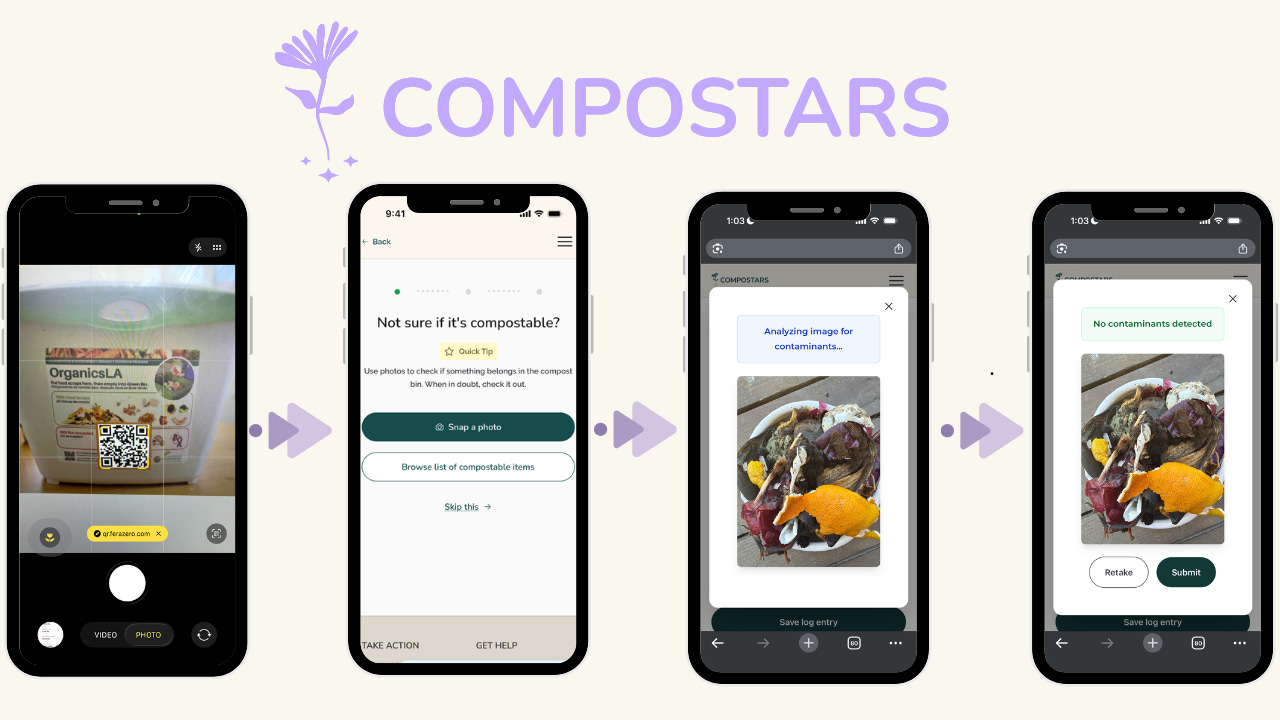
This is the texture of the work. Specific. Local. Sometimes slow and messy. But most importantly, it’s doable. The next time you are standing at the bin, holding something and uncertain — ask us!
Our compost concierge tool is in beta, and you can check it out here. We’re growing a community of Compo✨STARS✨. Join our constellation!
Meanwhile, a good rule of thumb to compost (and live by), is that if it grew from the earth, walked or swam the earth, it’s compostable. Granted, if you’re working with a backyard pile, there’s nuance here. But that’s for my next post.
Subscribe to stay in the loop on how we’re closing the loop for compost.
Until then,
— Lauren